The US wants to see what you told HMRC
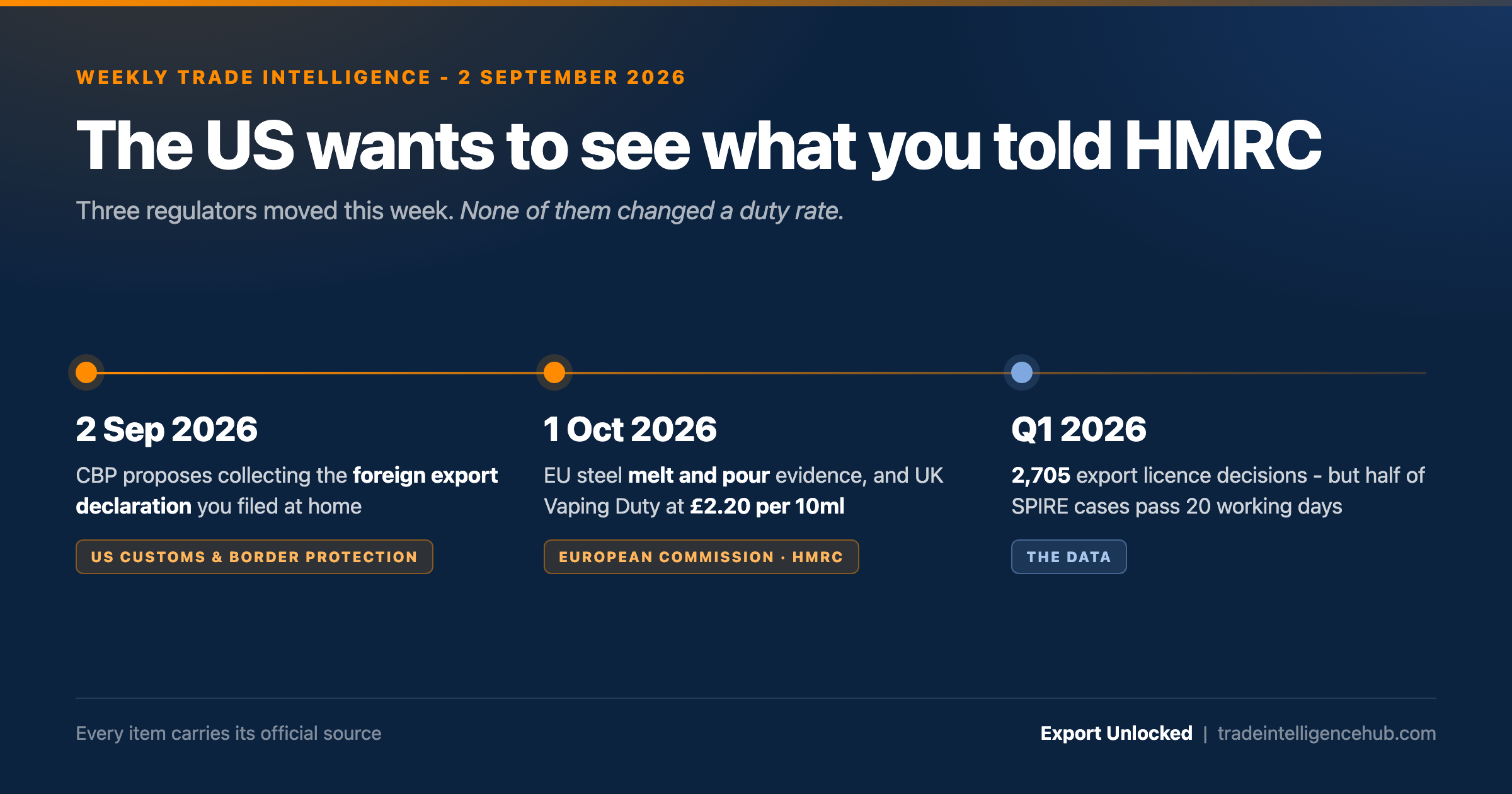
Welcome to the first weekly Trade Intelligence Briefing. Every item here carries the official source it came from, every item is from this week, and nothing is repeated from a previous issue. If we cannot source it, we do not print it.
Five items this week: a US proposal that should make every exporter to America look twice at their own paperwork, two rules that both bite on 1 October 2026, and two sets of official numbers — one of which is widely quoted and widely misread.
A thread runs through the first three. Not one of them changes a duty rate. All three change what you have to be able to prove.
1. The US wants to see the export declaration you filed at home
WHAT HAPPENED
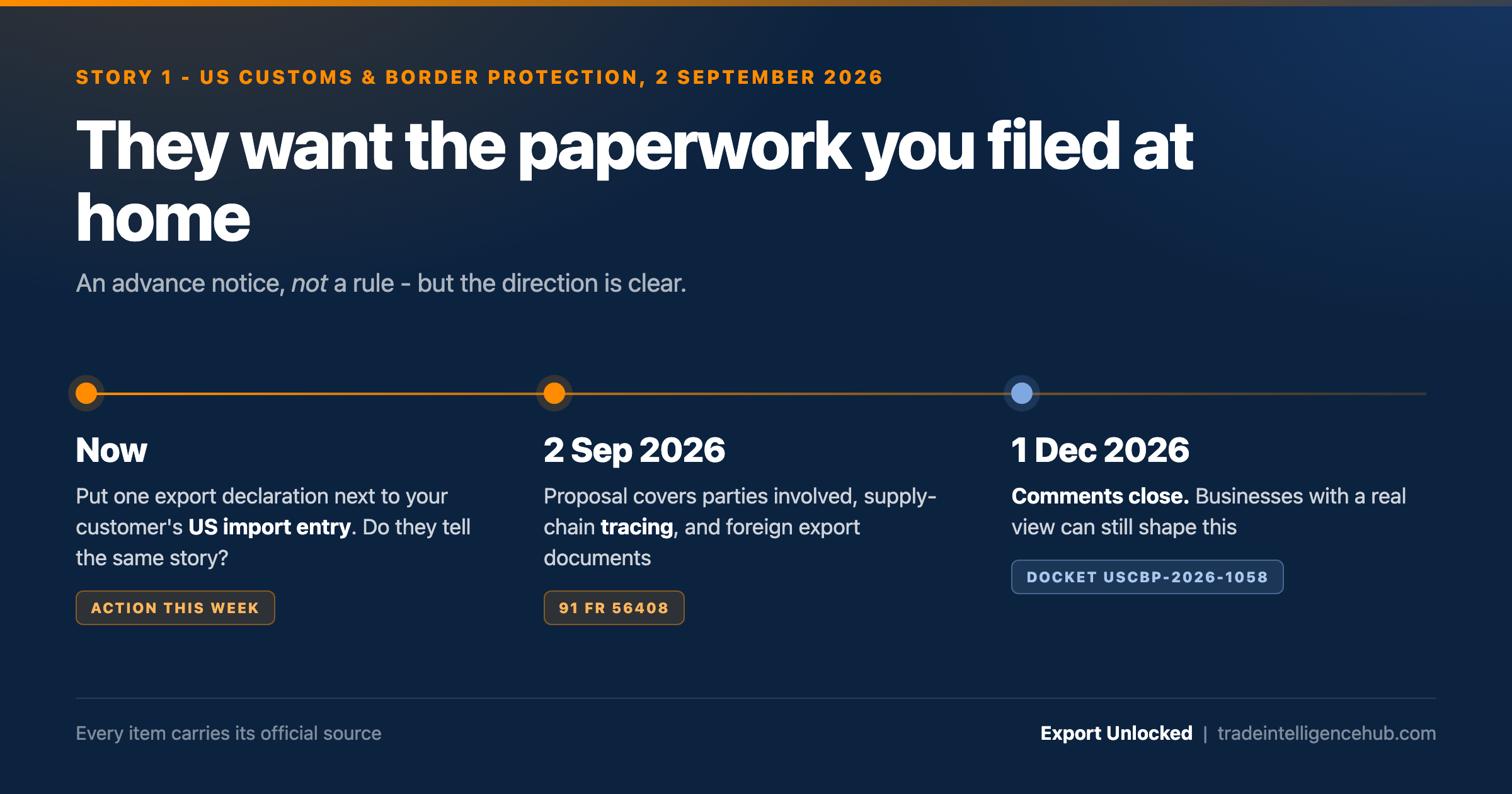
On 2 September US Customs and Border Protection published an advance notice of proposed rulemaking on Heightened Import Disclosures for Supply Chain Visibility. CBP is considering amending its regulations to get far deeper visibility into the supply chains behind goods entering the United States.
Three things are on the table. Greater visibility into the parties involved in an importation. Technical solutions for tracing the supply chain of those goods. And — the one that should stop UK exporters in their tracks — collecting the foreign export documentation that foreign exporters are required to submit to their own customs authority before the goods leave for the United States.
CBP's stated purpose is to detect and interdict illicit importations, particularly goods illegally transshipped to evade US customs and trade law.
This is an advance notice, not a rule. Nothing changes today. Comments close on 1 December 2026.
SOURCE
U.S. Customs and Border Protection, Department of Homeland Security, 2 September 2026 — Heightened Import Disclosures for Supply Chain Visibility, 91 FR 56408, Docket USCBP-2026-1058, RIN 1685-AA47, amending 19 CFR Parts 141, 142, 143 and 163.
WHY THIS MATTERS
CBP does not name any one country's paperwork. But for a UK exporter, the document that answers that description is the export declaration lodged with HMRC. Read plainly, a US customs authority is proposing to read what you told your own customs authority — and to compare the two.
That is a different kind of exposure from anything in a tariff schedule. Today your export declaration and your customer's US import entry are prepared by different people, in different systems, on different sides of the Atlantic, and nobody routinely puts them side by side. Under this proposal somebody does. Every difference between them — value, description, origin, quantity, consignee — becomes a question.
Most of those differences are innocent. A commercial invoice value that includes freight on one side and not the other, a description written for a UK classification and rewritten for a US one. Innocent, and still a discrepancy someone has to explain.
The transshipment target matters too. If your goods incorporate materials that were routed through a third country, the paperwork trail behind that routing is exactly what this is designed to expose.
WHO IS AFFECTED
Any UK business exporting to the United States, and anyone whose goods reach the US through a distributor or group company. It also reaches back up the chain: if you supply someone who exports to the US, their evidence problem becomes a question they ask you.
ACTION
This is a consultation, so the useful move is not panic but preparation. Pull one recent US shipment and put your export declaration next to your customer's import entry. If the two tell the same story, you are in good shape. If they do not, you have until at least 1 December — and realistically longer, since this is only an advance notice — to work out why. Businesses with a real view can also comment.
2. The EU now says exactly what you must hold to prove where steel was melted
WHAT HAPPENED
On 31 August the European Commission adopted an implementing act setting out precisely which documents an importer must hold to prove the country where steel was "melted and poured" under the EU Steel Regulation, which came into force on 1 July 2026. Member States backed it unanimously on 19 August.
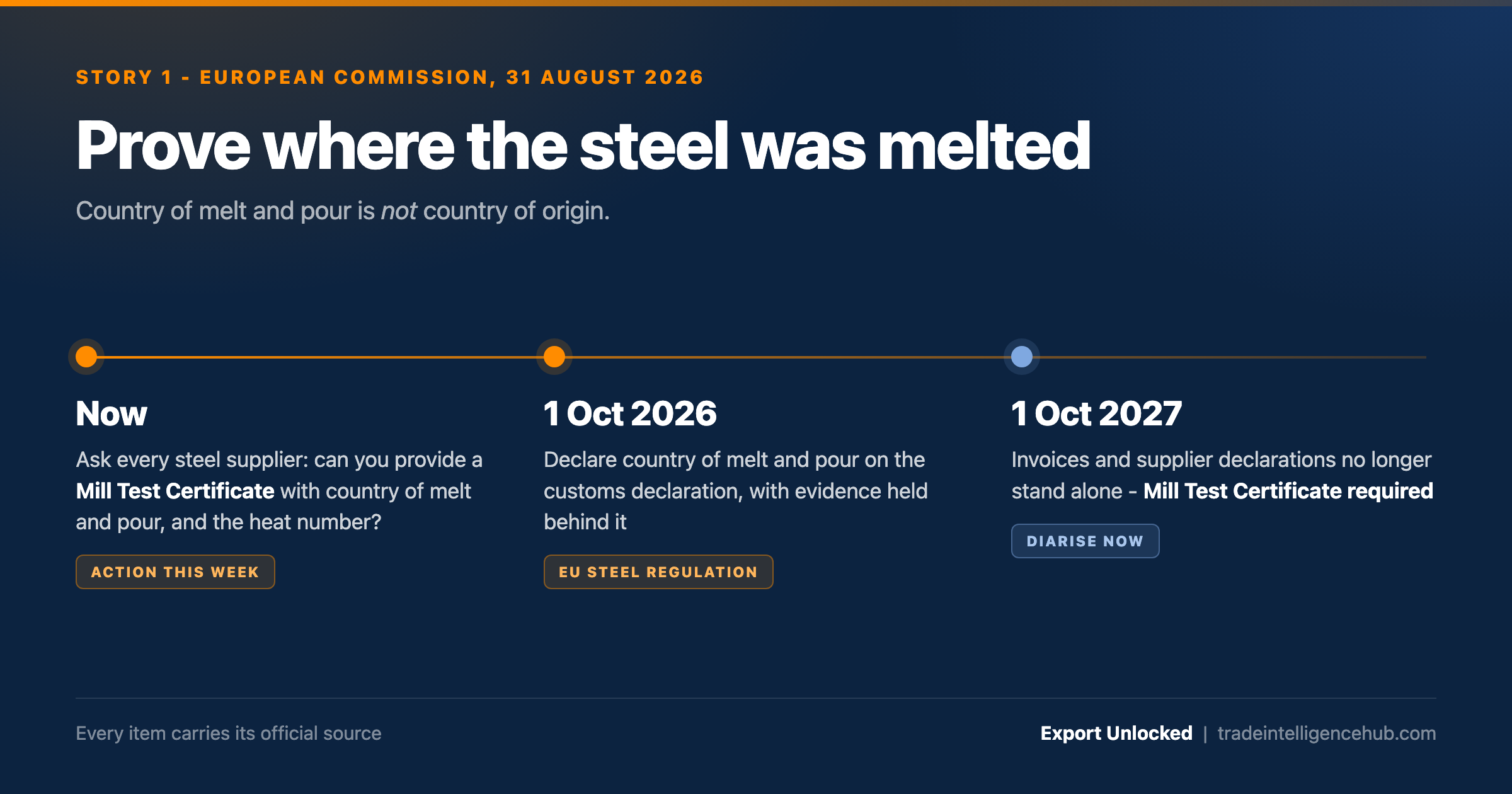
The primary evidence is a Mill Test Certificate showing the country of melt and pour and the heat number. Where that certificate is unavailable or incomplete, the Commission will accept invoices and delivery notes, quality certificates, purchase orders or contracts containing the relevant clauses, supplier declarations, cost accounting and production documents, customs documents from the exporting country, commercial correspondence, and production descriptions.
From 1 October 2026, importers must declare the country of melt and pour on the customs declaration and hold that evidence behind it. The measure applies to all origins except EEA countries.
There is a second date worth diarising now. From 1 October 2027, those alternative documents will only be accepted as complementary to a Mill Test Certificate — not as standalone proof.
SOURCE
European Commission, Directorate-General for Trade, 31 August 2026 — Commission sets type of evidence to be provided by importers to prove country of 'melt and pour' of steel products
WHY THIS MATTERS
Country of melt and pour is not country of origin. A coil can be rolled, cut, coated and finished in one country and still have been melted somewhere else entirely — and it is the melting that this regulation cares about. Businesses that have spent years getting comfortable with their origin position can be completely exposed on a question they have never been asked before.
The deeper point is where the burden now sits. This is a declaration made by the importer, supported by a document produced by a mill that may be several tiers up the supply chain and under no obligation to you. If your supplier cannot get the heat number from their mill, you are the one making the declaration you cannot support.
And the year's grace is not grace. It is a warning that the fallback documents stop working in October 2027. Anyone planning to lean on invoices and supplier declarations is planning to redo this exercise in twelve months.
WHO IS AFFECTED
Any business importing steel products into the EU from outside the EEA — directly, or as components inside something else. Construction, automotive, machinery, fabrication and industrial supply chains first. If you import into the EU through a group company or a distributor, the obligation still traces back to the declaration.
ACTION
Ask one question of every steel supplier this week: can you provide a Mill Test Certificate showing country of melt and pour and heat number? The answer sorts your supply base into three groups — those who can, those who can with notice, and those who cannot. The third group is your October problem, and you want to find them now rather than at the border.
3. One month until UK Vaping Products Duty — and it catches importers, not just manufacturers
WHAT HAPPENED
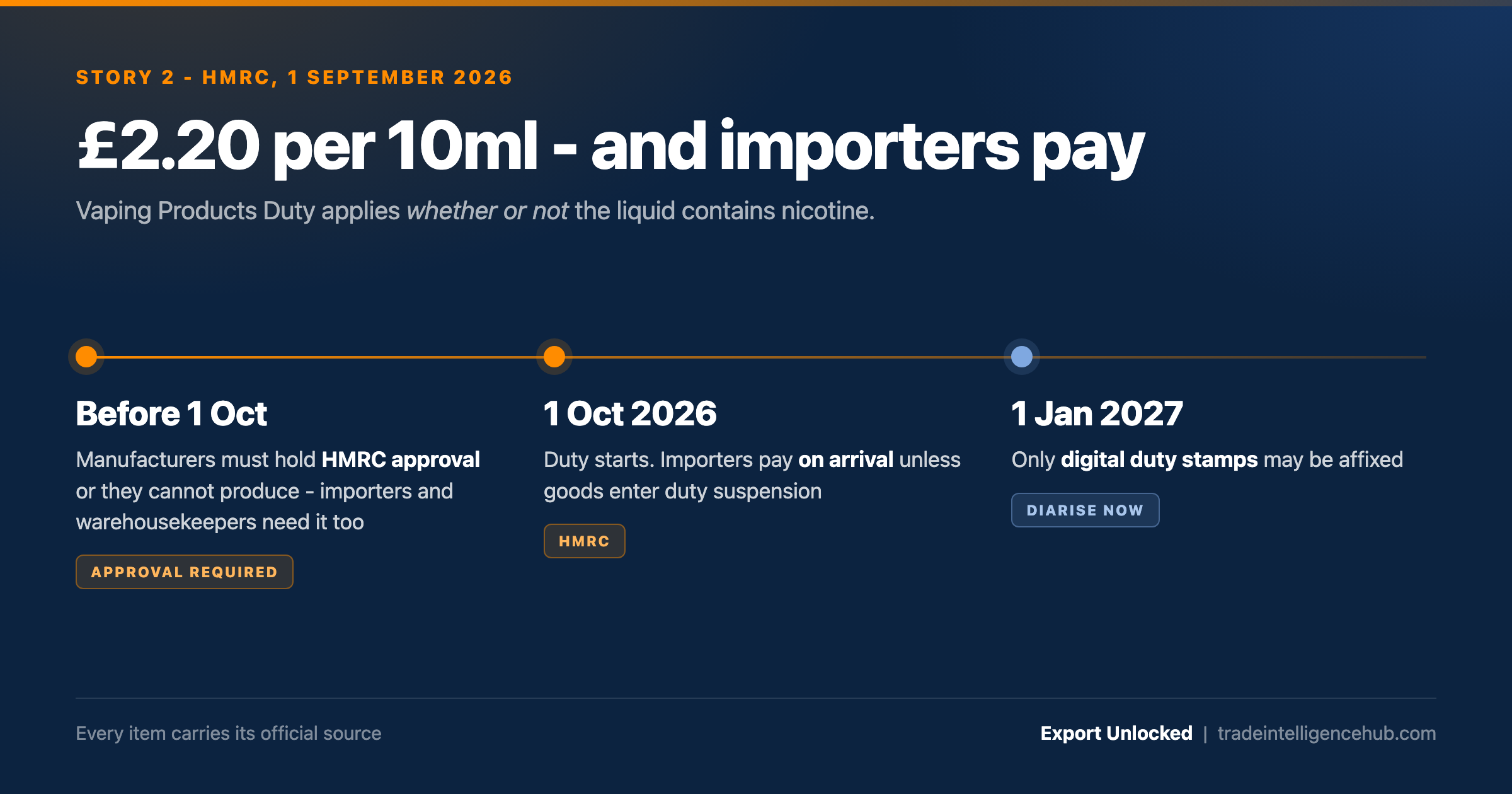
HMRC confirmed on 1 September that Vaping Products Duty and the Vaping Duty Stamps Scheme start on 1 October 2026. It is a new excise duty on all vaping liquids manufactured in, or imported into, the UK — whether or not they contain nicotine — at £2.20 per 10ml.
Approval is required for manufacturers, UK representatives of overseas manufacturers, warehousekeepers storing duty-suspended product, and importers. Businesses that only sell or distribute duty-paid product at wholesale or retail do not need approval.
Manufacturers must hold HMRC approval before 1 October or, in HMRC's own words, "cannot produce vaping products in the UK and may be unable to trade". Importers pay the duty when goods arrive, unless the goods enter a duty suspension arrangement such as an approved customs warehouse. All duty-liable product released for sale needs a valid duty stamp, and from 1 January 2027 only digital stamps may be affixed.
SOURCE
HM Revenue & Customs, 1 September 2026 — One month until Vaping Products Duty and the Vaping Duty Stamps Scheme start
WHY THIS MATTERS
Two details do the damage here. The first is "whether they contain nicotine or not" — businesses importing zero-nicotine liquids have had no reason to think of themselves as excise traders, and now are. The second is the duty point: an importer pays on arrival unless the goods are in duty suspension. That is a cash-flow change, not just a cost change, and it lands on the same day the stamps regime starts.
There is also a quiet structural point. Duty suspension via an approved customs warehouse is the difference between paying at the border and paying at release. That is a customs authorisation decision with a lead time — and lead times do not care that the deadline is a month away.
WHO IS AFFECTED
UK importers and manufacturers of vaping liquids, UK representatives of overseas manufacturers, and warehousekeepers. Distributors and retailers handling duty-paid stock are outside the approval requirement — but should confirm their supplier is inside it.
ACTION
If you import vaping liquids: confirm whether you need approval, and apply now rather than in late September. If you are considering duty suspension, start that conversation this week — an authorisation you apply for on 25 September will not be in place for 1 October.
4. THE DATA: 2,705 export licence decisions, and a slower queue
WHAT THE DATA SAYS
The Export Control Joint Unit published its licensing statistics for 1 January to 31 March 2026 on 27 August.
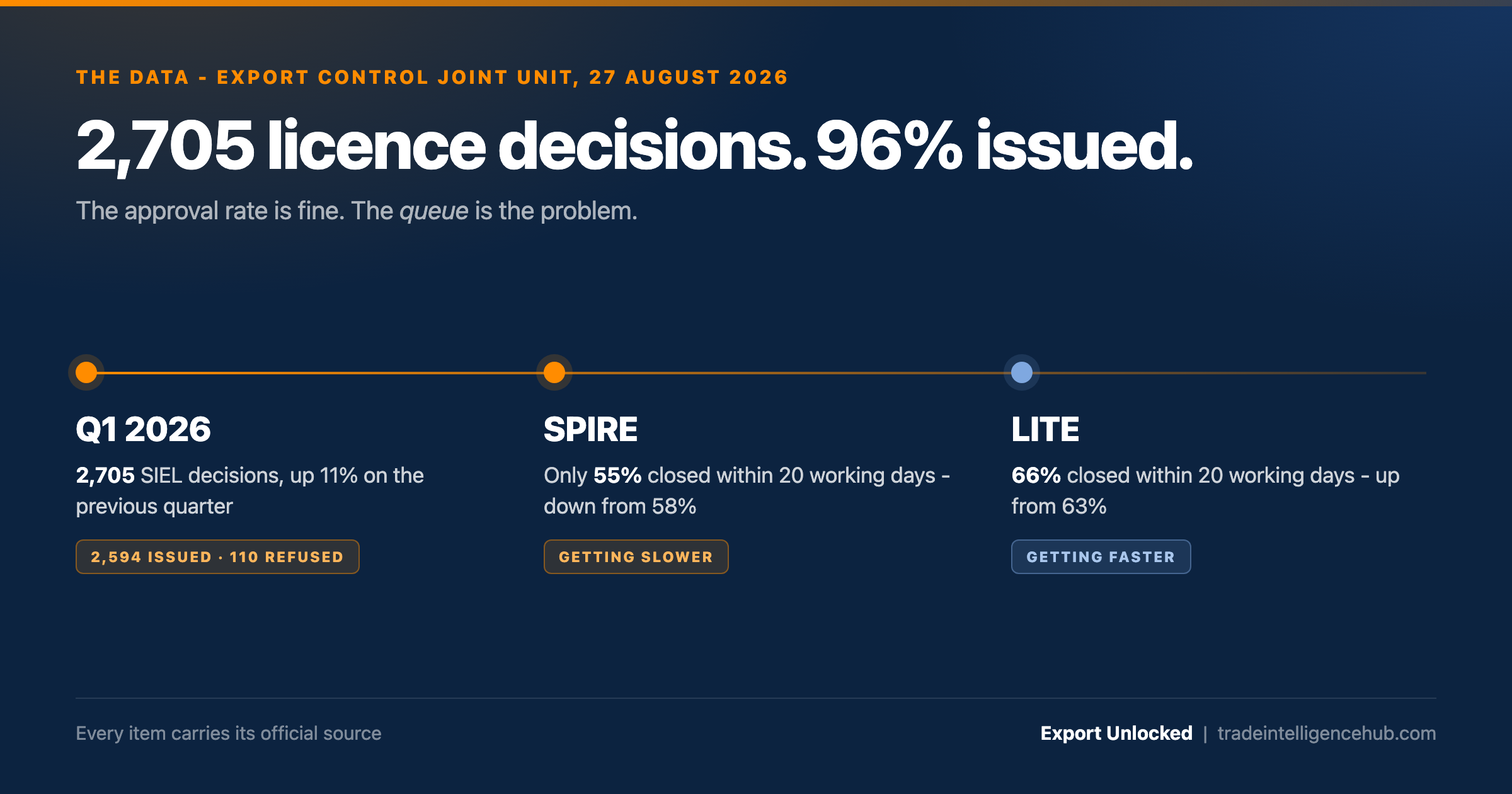
There were 2,705 licensing decisions on standard individual export licences (SIELs) in Q1 2026 — up 262 (11%) on the 2,443 decisions in Q4 2025.
Of those: 2,594 issued (96%), 110 refused (4%), and 1 revoked.
Processing time is the number worth watching, and it depends on which system your application sits in. In the older SPIRE system, 55% of applications closed within 20 working days — down from 58% the previous quarter. In the newer LITE system, 66% closed within 20 working days — up from 63%.
The full-year picture is a decline. In calendar 2025 there were 10,921 SIEL decisions, down 494 (4%) on 2024's 11,415, with 95% issued and 501 refused. SPIRE's 20-day performance fell from 60% to 51% across that year, and its 60-day performance from 84% to 72%.
SOURCE
Export Control Joint Unit, 27 August 2026 — Strategic export controls: licensing statistics, 1 January to 31 March 2026. Official Statistics in Development.
WHY THIS MATTERS
A 96% approval rate is reassuring and slightly misleading. It describes applications that were made — it says nothing about the exports nobody attempted because the timeline did not work.
The timeline is the real story. If you are on SPIRE, roughly one application in two now takes longer than 20 working days, and that has got worse two years running. Almost three in ten take longer than 60 working days. A licence you assumed would take a month can take three, and a customer who was told six weeks does not care which licensing system you are on.
There is a second point buried in the same release. ECJU describes itself as part of the Department for Business, Innovation, Science and Trade (BIST), and refers to "the former Department for Business and Trade (DBT)". If your procedures, templates or training materials name DBT, they now name a department that the department itself calls former.
WHO IS AFFECTED
Anyone exporting controlled goods, dual-use items, military-list goods or technology — and anyone quoting delivery dates that depend on a licence being granted.
ACTION
Stop quoting licence lead times from memory. Check which system your applications go through, and build the 60-working-day case into any quotation that depends on a licence, rather than the 20-day case you hope for. And check whether your documents still say DBT.
5. THE DATA: 243 export wins, £2.6 billion — and what that figure is not
WHAT THE DATA SAYS
Also on 27 August, government published Export Wins globally: April to June 2026.
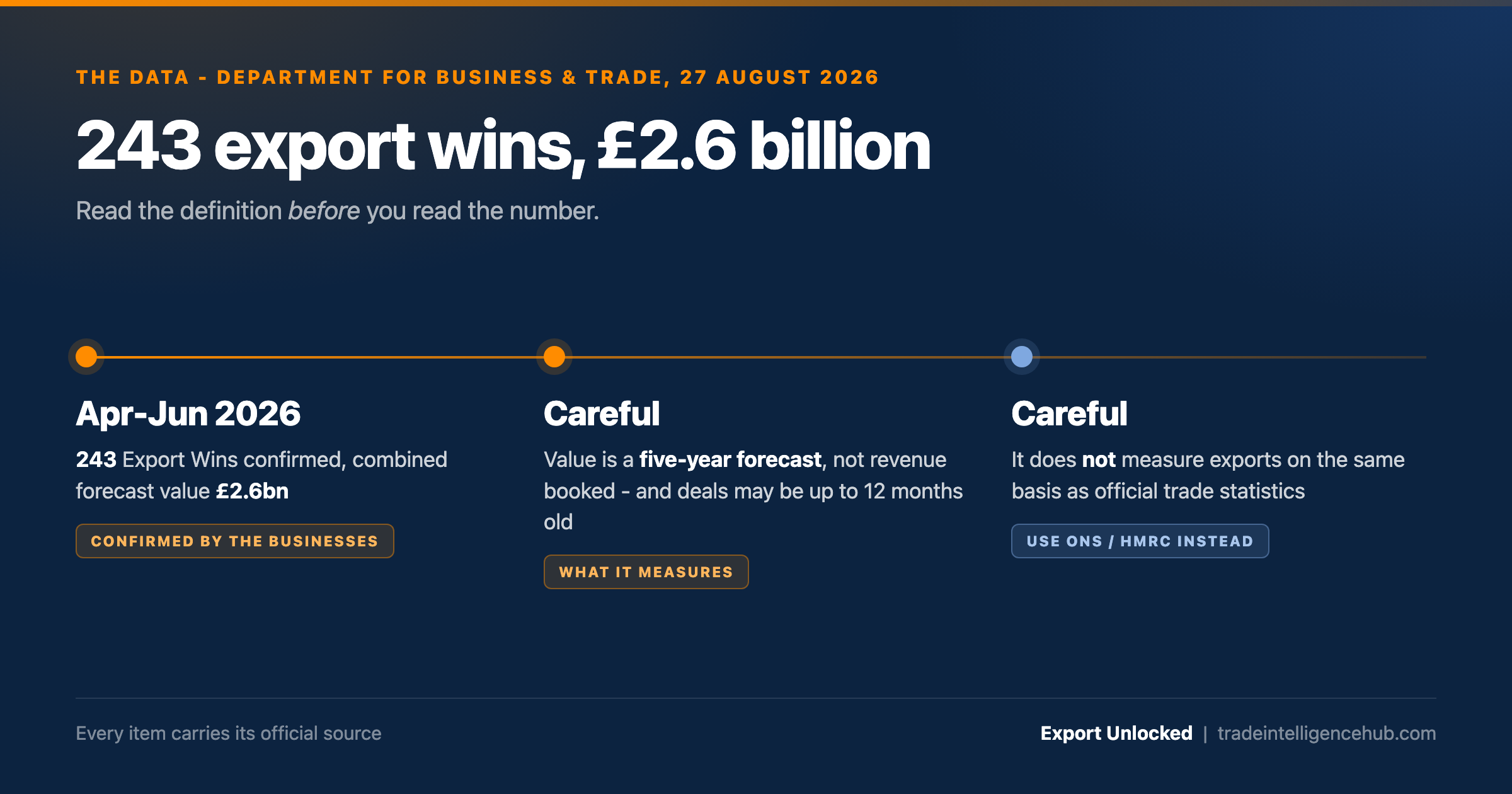
243 Export Wins with a combined forecast value of £2.6 billion were confirmed by UK businesses in April to June 2026, as having been won during the previous 12 months with government export-promotion support.
SOURCE
Department for Business and Trade, 27 August 2026 — Export Wins globally: April to June 2026 confirmed results.
WHY THIS MATTERS
Read the definition before you read the number, because the release is unusually candid about what it is measuring.
A Win's value is a forecast over the following five years, not revenue booked. The deals were confirmed in the quarter but "may have been won up to 12 months earlier". The value is entered by a lead officer and confirmed by the business itself. And the release states plainly that the metric "does not capture exporting activity on the same basis as measured in official trade statistics" — for that, it points you to ONS and HMRC.
So £2.6 billion is not £2.6 billion of exports in a quarter. It is the five-year forecast value of 243 deals confirmed in a quarter, self-reported by the businesses that won them.
That is not a criticism — it is a departmental performance measure doing what it was designed to do. The mistake is treating it as market data. If you are building a market case, use the OTS and ONS trade statistics. If you are asking whether government export support ever converts into deals, this is the honest answer: 243 businesses say it did.
WHO IS AFFECTED
Anyone weighing up whether to use government export support, and anyone who has seen this figure quoted as evidence of export growth.
ACTION
If you have never used the support, 243 confirmed wins in a quarter is a reasonable reason to look. If you are quoting the figure, quote it accurately — forecast value, five years, self-confirmed.
THE FORWARD LOOK
1 October 2026 carries two hard deadlines: EU steel importers must declare country of melt and pour with evidence behind it, and UK Vaping Products Duty starts. Neither is a target date.
1 December 2026: comments close on the US CBP supply-chain visibility proposal. The rule itself will come later, but the shape of it is being decided now.
1 January 2027: UK vaping duty stamps become digital-only.
1 October 2027: EU steel importers lose the fallback documents — Mill Test Certificate or nothing.
THE PRACTITIONER'S POINT
Three regulators moved this week, on three different subjects, in three different jurisdictions. Nobody's duty rate changed.
The EU decided what document proves where steel was melted. HMRC brought a new category of business inside the excise system. CBP proposed reading the export declaration you filed with your own customs authority. Different problems, one direction of travel: the burden is shifting from paying the right amount to proving you were entitled to.
That is a harder thing to be good at. A duty rate is a number you can look up and check. Evidence is a process — it depends on suppliers you do not control, documents produced months before you needed them, and records kept by people who did not know they would matter. You cannot fix it at the border, because by then the question has already been asked.
And it is worth noticing what the export licensing numbers say alongside all this. A 96% approval rate, and half of SPIRE applications taking longer than 20 working days. The permission is usually granted. The time is what caught people out.
The businesses that handle this well will not be the ones who read the regulations fastest. They will be the ones who already knew which supplier could produce a certificate, which system their licence sits in, and whether their export declaration says the same thing their customer's import entry does.
The Weekly Trade Intelligence Briefing is published every Wednesday by Export Unlocked. Every item carries the official source it came from — if we cannot source it, we do not print it.